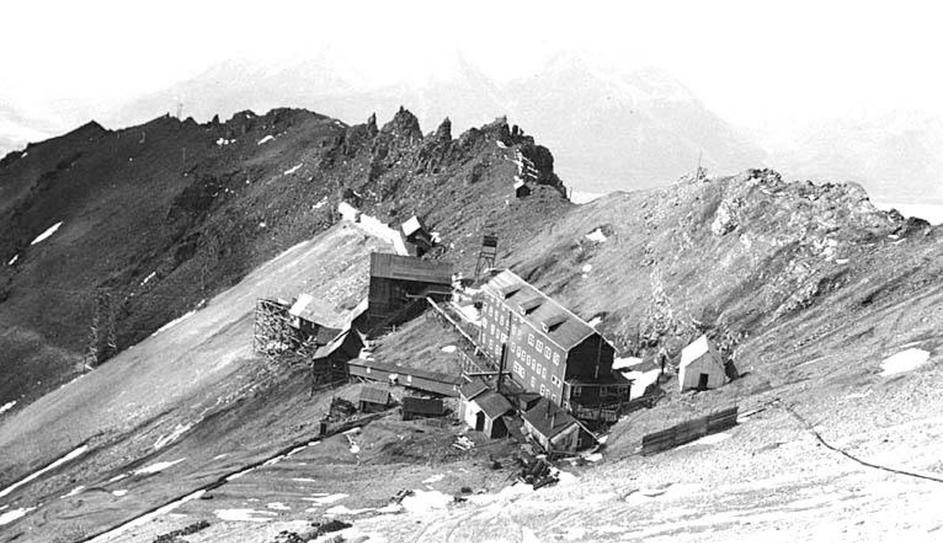
. English: Bonanza Mine, near Kennecott, ca. 1912 . English: PH Coll 247.864 In the summer of 1900, prospectors Clarence Warner and 'Tarantula Jack' Smith were exploring the east side of the Kennicott Glacier. As they drew closer to the limestone-greenstone contact, they could not miss the magnificent green cliffs of copper perches on the mountainside. Their discovery was staked as the 'Bonanza mine outcrop'. A young and ambitious mining engineer, Stephen Birch, later purchased this claim. Birch was financially backed by some of the most influential families of the time, including the Morgans and Guggenheims. Originally called the Alaska Syndicate, it became the Kennecott Copper Corporation in 1915. (The mining company was named after the Kennicott Glacier. It was misspelled as Kennecott, with an 'e' instead of an 'i'.) Along with the building of the mine and mill works, the corporation controlled the entire transportation route. It funded 196 miles of railroad from Kennecott to Cordova, and organized a steamship line that shipped the ore to the smelters in Tacoma, Washington. From the first shipment of high grade copper ore in 1911 to the final shipment in 1938, approximately $200 million worth of copper traveled the Copper River & Northwestern Railway to the port of Cordova. At its peak, the Kennecott Copper Corporation employed about 600 people: approximately 300 in the mill camp, where the ore was processed, and 200-300 lived in the mines up the mountain. Subjects (LCTGM): Kennecott Copper Mine (Alaska); Kennecott Copper Corporation--Facilities--Alaska--Kennicott; Kennicott Glacier (Alaska) Subjects (LCSH): Copper mines and mining--Alaska--Kennicott . circa 1912 7 Bonanza Mine, near Kennecott, ca 1912 (THWAITES 388),Image: 1018252842, License: Rights-managed, Restrictions: , Model Release: no
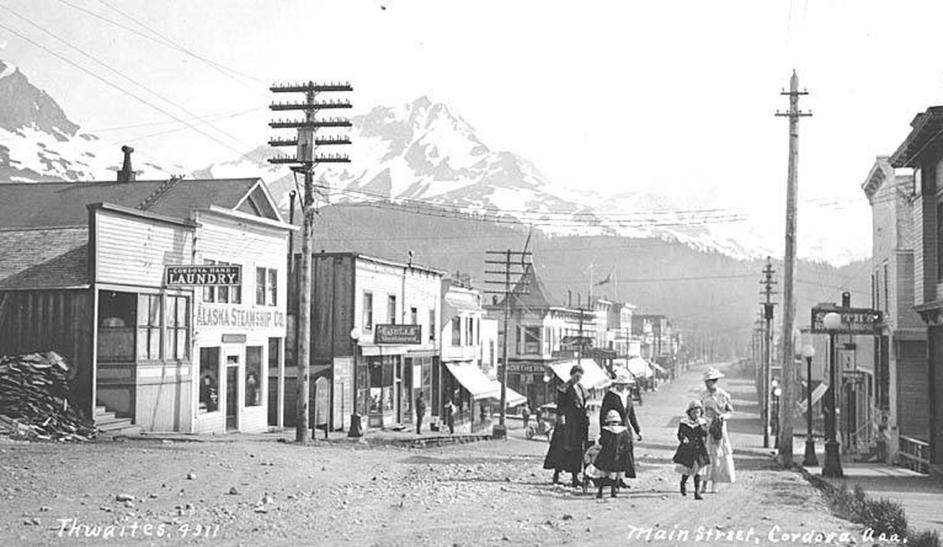
. English: Women and children on Main Street in Cordova, ca. 1912 . English: Caption on image: Main Street, Cordova, Aaa . PH Coll 247.605 Cordova is located at the southeastern end of Prince William Sound in the Gulf of Alaska. The community was built on Orca Inlet, at the base of Eyak Mountain. It lies 52 air miles southeast of Valdez and 150 miles southeast of Anchorage. The area has historically been the home to Aleuts, with the addition of migrating Athabascan and Tlingit natives who called themselves Eyaks. Alaskan Natives of other descents also settled in Cordova. Orca Inlet was originally named 'Puerto Cordova' by Don Salvador Fidalgo in 1790. One of the first producing oil fields in Alaska was discovered at Katalla, 47 miles southeast of Cordova, in 1902. The town of Cordova was named in 1906 by Michael Heney, builder of the Copper River and Northwestern Railroad. Cordova became the railroad terminus and ocean shipping port for copper ore from the Kennecott Mine up the Copper River. The first trainload of ore was loaded onto the steamship 'Northwestern' bound for a smelter in Tacoma, Washington, in April 1911. The Bonanza-Kennecott Mines operated until 1938 and yielded over $200 million in copper, silver and gold. The Katalla oil field produced until 1933, when it was destroyed by fire. Fishing became the economic base in the early 1940s. Subjects (LCTGM): Cities & towns--Alaska; Streets--Alaska--Cordova; Women--Alaska--Cordova; Children--Alaska--Cordova Subjects (LCSH): Cordova (Alaska); Main Street (Cordova, Alaska) . circa 1912 82 Women and children on Main Street in Cordova, ca 1912 (THWAITES 266),Image: 1018193079, License: Rights-managed, Restrictions: , Model Release: no
Image: 988058799, License: Rights-managed, Restrictions: , Model Release: no